That doesn’t even make sense! Aren’t I supposed to be all “More Women Speaking”?!? Well yes. Here’s the thing – after reading a lot of the abstracts, seeing how many people submitted, and knowing mine was kinda niche AND that I had rushed my general session submission- I realized it shouldn’t have made the cut.
There I said it.
At some point I even did some back of the napkin math and realized purely from an odds standpoint (all other things being equal), I had about an 8%-11% chance of being selected. After reading a lot of abstracts I realized that if I HAD been selected, then that would have meant I was selected more because I was a woman, and not because it was a submission that rose to the top. And that is DEFINATELY not what I would want. Yea, yea, I realize that some of this is arbitrary because it’s based on different volunteers’ opinions, but I still would have felt a bit sad if mine had made it after reading others, and I would have thought my gender played a role.
You see, a lot of my younger years I was sometimes told I was selected for things because I was a woman. Often by people not even in my field. In one case, by a [male] friend of mine! People that had never worked with me and didn’t have my bosses handy to tell them different. And I have no qualms telling you that my bosses would. Case in point: my last boss CC’d me on an email he sent to another person touting me as “The Purple Unicorn they were looking for”, without telling me beforehand. (This was after I left the company and ironically, I wasn’t even looking for a new position.)
Being a Woman In Technology doesn’t mean I want my voice risen above others. That would imply that we care about gender over quality. Even worse – it would imply that there isn’t enough quality women voices, and that simply is not true. (I’d argue that it is often the opposite problem with more average men in the industry – simply based on numbers.) Plainly put, I want our industry to figure out WHY it’s difficult to get more women speakers and address it from that problem. Heck, lets tackle why so many of us leave IT and how to put more women in the pipeline while we are at it. Wait, I have a whole list of things if you really want to get me going…
But back to the main topic: I wasn’t selected for PASS and that’s how it should be. Remember how I said I rushed my general submission and it was kinda niche? Turns out there are 2 similar sessions that made it and though they are not the exact same as mine, they are with same core technologies and are less niche then my submission. And with better abstracts. One is being presented by a woman and one by another under-represented group. I’ll be sure to attend.
Admitting this is my first T-SQL Tuesday contribution seems a bit weird for me to write. I mean I’ve been in this industry over 20 years. (Ok, maybe 25 is more accurate.) I’ve been in the sql community for well over a decade.
But when one of my favorite authors, #sqlfamily rockstar, and all-around awesome human being Louis Davidson, posted on it earlier this month, I was intrigued. He wanted us to answer the question: What advice do you wish Current You could go back and give past you as you were starting your first data platform job?
At first I was giddy about all the things I could write about. But the more I thought about it, the harder it became. Do I write from a technical standpoint? Process? Personal? And what about the Butterfly effect? If Current Me gave first data platform me advice, couldn’t that completely alter where I am now in all aspects? Clearly I was going down a rabbit hole, which explains why I am writing this now on Tuesday evening at 11:33 PM. (Apologies in advance for any typos.)
So on some unexpected errands I had today, I had a little downtime and pulled out my little notepad to make a list. Immediately I saw a problem that I hadn’t even considered: things that I hold to be very important to me today, I couldn’t have heeded that advice 20+ (25) years ago. Things I take for granted and can easily say or do today, as a young women in tech I couldn’t do many years ago. Or at least “I” didn’t feel like I could.
“Speak up for yourself”. “A company won’t love you back – so outside of work hours only give them what you want to take away from your family or have a genuine interest in doing.” “Delegate more” “Don’t knowledge hoard.” “Don’t be afraid to admit when you don’t know something.”
And while each of these things are spot on, when I was a single mom with a mortgage living pay check to pay check and had to a.) make myself invaluable and b.) make myself likable/agreeable/whatever-else-you-want-to-call-it, those things often conflicted with real life. Things are not always as easy as they sound. Especially as a woman. The times I didn’t do both a and b, I’d get into trouble.
Going no where with any of those things, I moved to looking at things from a technical perspective. That wasn’t helpful either; I’ve always followed where the jobs were and most of my jobs only resembled each other because “data” was in the name. That’s given me a pretty wide (if not always deep) range of experience. My ADHD loves it. I’ve had a lifetime of “learn this new thing really fast” and its been fantastic.
Striking both personal and technical things off my list (ok fine, I didn’t have anything technical on my list- though my calibre library will call me a liar on that one), I guess I am left with Process. Which it a good thing because I have about 4, no 3 minutes until the midnight bell tolls. Here it goes: “Use Checklists as often as you can” and “Learn and Use Value / Effort matrixes” (Is that even allowed to be plural?) Oh yea, and don’t sweat the typos. They’ll throw you under the bus for time – every time.
Let me start this post saying I 100% empathize with the difficulties women and other underrepresented groups face with speaking. I won’t go into a dissertation on the multitude of whys in this post – except to say for me, a big part really boils down to time. And how little I often have.
But… I also know the importance of being represented. And as a neurodiverse woman that has grown up with interests where I was often the minority – I have a lifetime of frustration with having to learn things mostly from a man’s POV. That’s not to say that it doesn’t have value – it does! Tons! But lots of examples used in training things DO. NOT. EXCITE. ME. And my very unscientific polling of people shows that many do not even understand why having diversity and things that excite others, is important; even just from the perspective of getting a diverse pipeline in the IT industry.
All this to say: I run a Microsoft Data Platform user group and I want to hear your voice. I want you to know your voice is important to hear.I want you to know your voice is needed. It’s important for other women, other underrepresented groups, and yes, even for men.
That’s the easy part: saying tech needs you to speak. Across the board from my user group and with other user groups/conferences, we are seeing a serious drop in women speakers. The hard part is figuring out the logistics. Because as much as I can spout my stories all day of why it is difficult for me, I’ll bet there are 100s of reasons I haven’t considered for others. If we don’t know all the reasons, then it’s difficult to come up with solutions. So first – I invite you to tell me your reason.
Second, I realize that sometimes it has to do with confidence or inexperience. Women in tech in particular, tend to be perfectionists IME, so to speak can be a bit daunting. If that’s the case, then please please please consider applying to New Stars of Data. Why would you apply to speak if you have confidence issues or inexperience??? Because the NSoD program will assign you a mentor that will help you as much or as little as you want to overcome any real or perceived issue you may have with your abilities. (Hint: women tend to underestimate their capabilities, while men overestimate.)
Third: Reach out to me on how I can best get you an opportunity speak. This includes all people that fall into underrepresented groups. (I realize I often refer to women specifically, but this applies to all that fit in this category.)
Want to find an in-person group? I will assist to help you find one.
Want to speak virtually? I’ve got you covered.
Don’t have the schedule to do either live? We can get you up on YouTube with something you record on your time.
Want to blog about something, but don’t want to do the whole “set up a blog thing?” I got you covered on that as well.
Want to have a group of women in tech to ping ideas off of? Yep. You guessed it. I know some people.
Want help with grammar? Ok. You’ve got me on that one. It’s not my strength.
HAVE I INTERESTED YOU EVEN A LITTLE??? Maybe just to start a conversation? Or maybe you want to join me in coming up with ways to help get more diversity in speaking? Ping me!
How do you contact me? That’s an easy one too: hit me up on linkedIn or X with a quick note. And if it takes me a little bit to get back to you, then know I’m in the same boat too, but I WILL get back to you.
On Today’s episode of “What’s the Problem in Synapse Now?” we take a look at Synapse Link for the Dataverse (shocker – I know.)
Let’s get right too it – we are talking about the error message: “You have not linked a Dynamics 365 Finance and Operations environment. Link an environment to see tables. See https://aka.ms/FnOTablesInSynapseLink“*. And oddly enough, our D365 F&O tab will have some variation of x of 0 selected.
Wait a minute – this was working perfectly fine a few days ago – ok – that may be – or maybe this is your first go at it, either way you are going to use the same solution.
So what do you do? Simple, close the managed tables tab. Next, and just as a precautionary, make sure you are in the correct environment, and that the environment is running. It’s not uncommon for lower environments to have a nightly shutoff switch. That’s probably not the cause, but it doesn’t hurt to check.
Now that you’ve checked the environment and have ruled that out, let’s discuss a common cause: your authentication has gotten boogered up. That’s the technical term for it: BOOGERED UP.
If using Managed Identity (which you should be), then the easiest fix is to click on that button at the top called Use Managed Identity.
That’s it. Soon you should see some movement for anything currently in place or if you were adding/changing some current tables, click on the Manage Tables button again to get back to where you were. Your error will hopefully be resolved. If you didn’t use managed identity with D365 F&O and Synapse Link, you may want to revaluate your life choices like I recently did. (JK – kinda of.) But if you didn’t, then you’ll have to make sure your storage account can talk to your Power Apps D365 F&O Synapse Link. I’ll save that rabbit hole for another day.
* Note, there is actually some good stuff in the link that the error message provides which at the time of this writing, resolves to: https://learn.microsoft.com/en-us/power-apps/maker/data-platform/azure-synapse-link-select-fno-data It’s a lot of information so hopefully this tip will save you a bunch of time reading through the whole thing. But if you are starting a Synapse Link for Dataverse from scratch, or if this post doesn’t correct your issue, definitely go back to that link and step through each part. It won’t be your first or last visit…
This error has become the bane of my existence – with multiple configuration setups. Basically, anytime I dared to change the Synapse workspace to not allow all access in the Network settings, I was bound to run into it. Today’s tidbit only addresses ONE way that might solve this error, but it is so maddingly simple that I decided to throw it up on my blog. I’ll save the rant of all the different rabbit holes I’ve been down in the last month for the “BEST PRACTICE SAYS YOU HAVE TO DO THIS <oh except it’s not allowed in these cases and I’m going to bury that information on some small page.>” Hopefully I’ll post all the different ways to address this problem at some point.
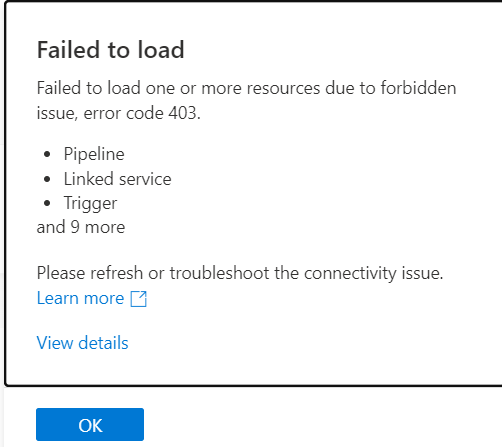
First let’s look at the error message that you see when you open up your Synapse workspace. “Failed to load. Failed to load one or more resources due to forbidden issue, error code 403.”
Hmmmmm, what is this “View details” you speak of?
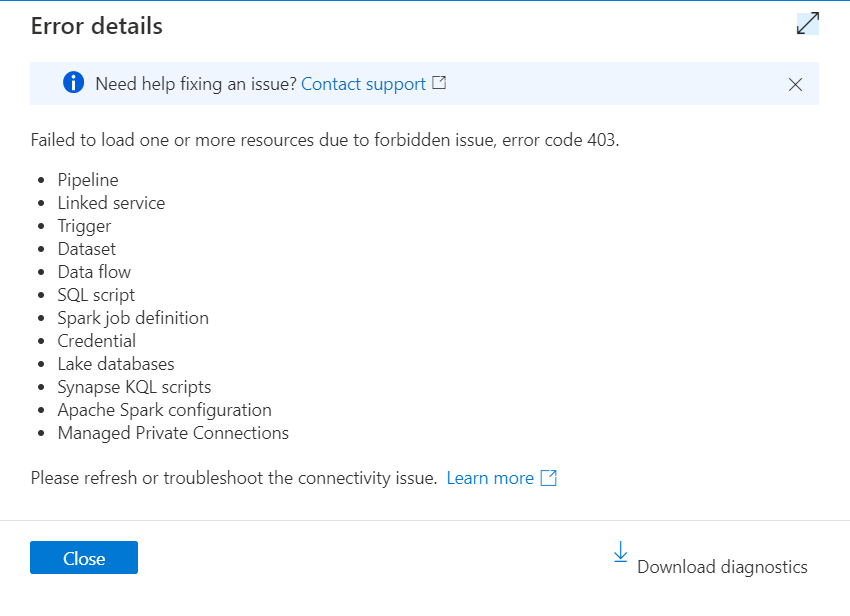
Oh, ok. It’s just really telling me all the things that aren’t working. Awesome. And don’t let that “download diagnostics” button fool you. It’s not going to tell you anything helpful. (I know, shocking.)
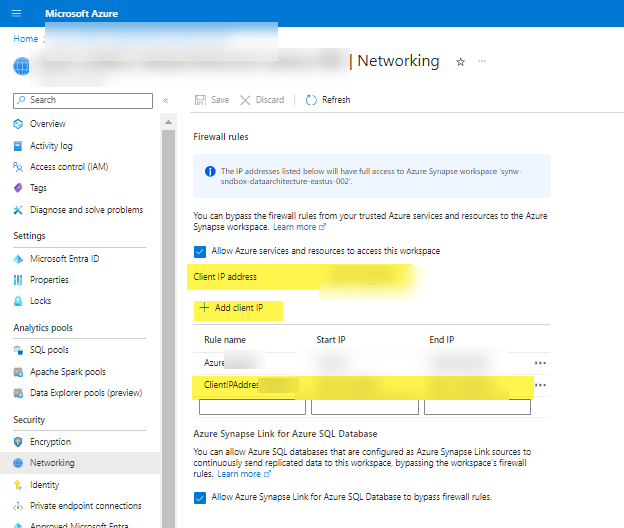
So what’s the 2 second fix you can check before getting lost down your own rabbit hole? A little thing in the Azure portal, under your Synapse workspace in the Network settings. Drum role……..make sure you have your own IP address (ahem, “Client IP address”) added as a rule with whatever other network rules you’ve got going on. ARE YOU FREAKING KIDDING ME?
If you are thinking “yea, duh, there is a little button that says ‘Add client IP'” then ShutIT. They put that image slam in the middle of one of the Microsoft Learn pages without context in the middle of something else completely, so by the time you (ok me) finish the other thing that the article was about, I’ve completely forgotten about this rando item. And apparently I’m not the only one because I’ve screen shared with a ton of super smart people (including MS peeps) and no one even noticed my IP wasn’t added.
For the record, my new mantra is “they created Fabric because they realized they had to simplify Synapse configurations. Microsoft realized too many people were getting pissed.”
UPDATE: If using PBI as a developer using desktop, you may have to add that person’s IP address to the firewall rules as well. Otherwise they may have issues refreshing tables.
Earlier this year, meetup sent their obligatory email about a group I was in needing a new organizer. Like most people during COVID, I joined a lot of online meetup groups after most groups moved their sessions online. The Kansas City SQL Server User Group (#KCSSUG) was no different and fast forward to 2023, one-by-one user groups were going back to in-person events.
Look, I get it. Lots of folks wanted to go back to the physical meetings to have that in-person interaction. But that option is not always available to people, and in particular, it often isn’t available to under represented groups for a myriad of reasons. I will let you do your own homework on why that is, but I can briefly speak to my experiences as a WIT. (Hmmmm, maybe that entire subject matter would make a good blog post all on it’s own.) I won’t even address it from a neurodiverse perspective.
A WIT Perspective
Here is a quick summary of my experience with it as a WIT: 25+ years ago, as a single mom, traveling to events wasn’t even an option. I was a young mother and my parents still were in the workforce and unable to take time off to babysit for me to go to a conference (though weekends were ok). Never mind school schedules. And even though I was in IT, money was pretty tight – so traveling costs were pretty prohibitive for me. (I once had to borrow money to buy basic groceries for a week.) None of my companies ever even considered paying for me to travel to a conference (or even attend a local conference), and I would have had to use PTO (personal time off – aka: sick /vacation time) to attend. If you are a parent, you know that PTO can often be eaten up by young children for NON vacation reasons and there simply was no room for me to chance it. Otherwise I might get docked pay and my review may come back that I had too many absences. Yes, folks, that’s how it is sometimes.
Think I’m exaggerating? Consider this: even though I was an organizer for SQL Saturday in Atlanta for 8 years, and I’ve been in the industry for over 25 years, last year was the first year I have ever traveled to a conference outside my local area that wasn’t on a weekend or that a vacation wasn’t planned around (PASS Data Community Summit 2022 in case you were wondering).* Even as an organizer, I used PTO to volunteer for our Atlanta Friday pre-con sessions. And I’m a seasoned IT Professional.
Random AI generated image of a seasoned female IT worker because I was curious after I typed that phrase.
*(All thanks to the wonderful company I currently work for: Kent Corporation. I finally work for a company that understands the importance of conferences and upskilling employees. There’s a reason they’ve won a ton of employee satisfaction awards. )
Online Options
All of this to build up to why I decided to step up as the organizer of the Kansas City SQL Server User Group: to continue to have online options for those that may need it. Be it speakers, or members, or anyone that wants to catch it on our YouTube channel. Not all of our sessions are recorded, for various reasons (including my first event where something messed up with the recording), but the majority are.
Our group isn’t the only group doing this, so I’m not doing anything ground breaking here: there are still plenty of great user groups and conferences that either have real-time online options or recorded ones – which is AWESOME. Last year SQLBits was in Wales and I was a online speaker for that conference. I wouldn’t have been able to speak at that one if they didn’t have the hybrid option and I’m forever grateful.(Side note: not only did I have many people join live online, but Andy Yun of #SQLFamily took pics for me of the in-person view. SQLBits even posted the videos a few months later; here’s mine: Migrating data solutions to the cloud – a checklist.) That said, as I was looking through my emails at the beginning of the summer, I saw the number of online options getting smaller and smaller.
Thinking of that, I decided to take action and become the organizer for the KCSSUG, and keep it virtual. I’m a strong believer that virtual options help play a role in DEI, and instead of complaining about the diminishing options, I could at least help in that area. All of this to say: now I’m officially the organizer for the (Virtual) Kansas City SQL Server Group.
Info About Our Group
Interested in seeing some of our sessions? We loosely follow a 2x a month schedule:
1st Tuesday of the Month in the early evening (5:45 PM CDT).
2nd Thursday of the Month as a Lunch and Learn (12 PM CDT).
The 2 different times allow us to cover people that can join in the evening and people that can do lunch and learns. It also allows us to include people in some additional time zones outside the US. Plus, it helps me not take up additional family time. As mentioned, we also have a YouTube channel that we post most of our events to afterwards. (Some quicker than others because – yea – my ADHD).
We occasionally have an additional session for guest spots with both regular speakers as well as speakers from Ben Weissman and Willaim Durkin‘s New Stars of Data. I’m particularly excited about giving new speakers an additional platform to gain experience and not just because #NSoD is where I got my start. Ok maybe I’m a little partial to them because I know all they do to help new speakers perform their best with their resources, mentors, and various volunteers that do all their magic.
Who are the amazing speakers we’ve hosted in the last 5 months?
And we have many more in the works for 2024 as well as new things coming down the line! Around February, we will have a new call for speakers to fill our remaining spots, so stay tuned (and submit!) If you’d like to volunteer to help host or join our team – feel free to reach out to me on linkedin or twitter.
Ok, so that’s it. Even I think this falls in the category TLDR, but I’ve haven’t written in awhile (at least not completed one, technically I’ve written a ton), so you get this big gush in one go. If you’ve made it this far – hope to see you soon (in-person AND online)!
As I try and balance speaking, taking over a user group this last summer (more on that later), and life in general – I’m reminded of this important post by Deborah Melkin a wonderful speaker, community advocate, and all around great human being. Please take the time to read.
This post is a continuation from Part 1: Preplanning and Evaluation in a 9 part series. If you want to download the full checklist or slides without all the wordy-word stuff: you can find it in this Github repository. (The checklist has wordy-word stuff. No getting around that.)
Topics covered today:
Digital Estate
Data Management
Data Lineage
Pilot Project
Digital Estate
Understanding your digital estate at the beginning of your project will help you determine what to assess and migrate down the road. Even if you already think you know all the things you need to migrate, it’s helpful to check how all of the things may be connected. You need to identify your infrastructure, applications, and all the dependencies. You don’t want any surprises! Don’t just rely on old documentation.
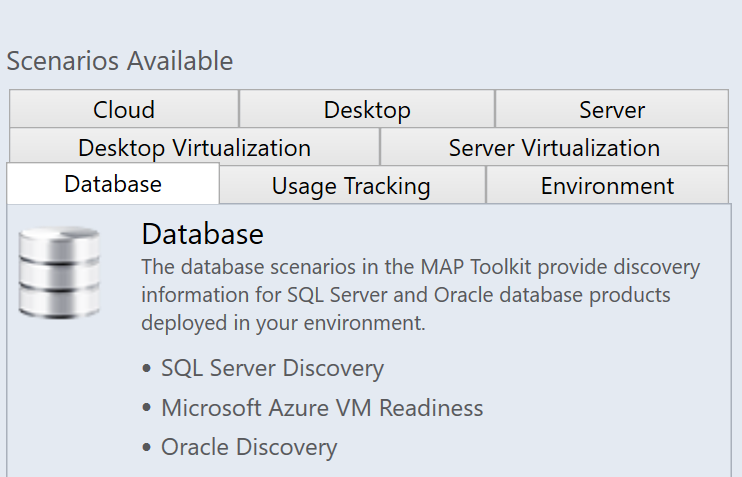
Azure Migrate has a Discovery and Assessment tool that can assist in this task, but there are certainly many other ways to acquire this information. You may have other 3rd party tools or internal processes that already gather this information for you. Just make sure that it is UTD. Personally, I really like the free pre-Azure Migrate solution: Microsoft Assessment and Planning Toolkit as it dumps everything in excel sheets that Admins and Management tend to like to see. But the visual display of Migrate (and ALL the additional tools) is pretty fantastic.
Some options available in the MAP Toolkit
Whatever tool you use, from a database perspective, you want to know things like what database systems are in your environment, what version and edition they are on, how many databases may be on an instance, what are the database names, file sizes, statuses, users, configurations, and other various database metadata. You are going to want to know some performance metric results and additional server details. You are going to want to know the various components that are installed on your servers, details about those components, and how they are used. Are you REALLY using those SSRS and SSAS components and if so, how?
Lastly, you want to make sure you know all of your relationships between applications, instances, database objects, and processes. It’s no fun to find out later that you had a database with hard-coded servers in some stored procedures or unknown linked server requirements. Or a SQL job that PBI Report Server created for each data refresh.
The Key Take-Aways here:
1.) Identify the infrastructure : things like servers
2.) Identify what apps do they use – this includes all your SQL server apps!
3.) And identify dependencies they may have: Internally and across servers. Don’t forget to include things like ports/networking
Data Management
Now is the time to find out what documentation you have about your data (and what you need to get). Having this information is essential if you determine you need to move things in parts or if you have overlap in data that might be potentially consolidated. This will help you down the road when we get into some architecture designs with the 5 Rs of rationalization. Our focus here is on having a data dictionary, a business glossary, a data catalog, and classifying your data.
A quick summary of these terms: a data dictionary helps you to understand and trust data in databases better, a business glossary provides a common language for the organization when it comes to business concepts and metrics, a data catalog helps you to find, understand, trust and collaborate on data, and data classification groups your data elements to make it easier to sort, retrieve, and store.
Why are these things important for migration? First off, they are important just from a data governance standpoint. But more than that, knowing this information up front can save you a lot of headaches down the road. You may have business requirements for some of your data to be labeled in a security context. Maybe you are dealing with highly classified government data, health care data, or HR data. Or you may find you have data type mismatches? And data catalogs often review hidden dependencies that you may not have otherwise known.
All is not lost if you don’t have all of this. Azure has some internal tools like Purview to assist with this, and there are plenty of 3rd party tools. If you are like me, you already carry a script toolbox from the lifetime of your career (some of those scripts from 20 years ago still work!) that you can easily use. Apart from the Business Glossary, there are so many free options and scripts out there that this should not be a showstopper for you. For the Business Glossary – you are going to have to go to the source – your subject matter experts (SMEs).
Data Lineage
In addition to the previous items we mentioned for data management, I want to call out data lineage specifically.
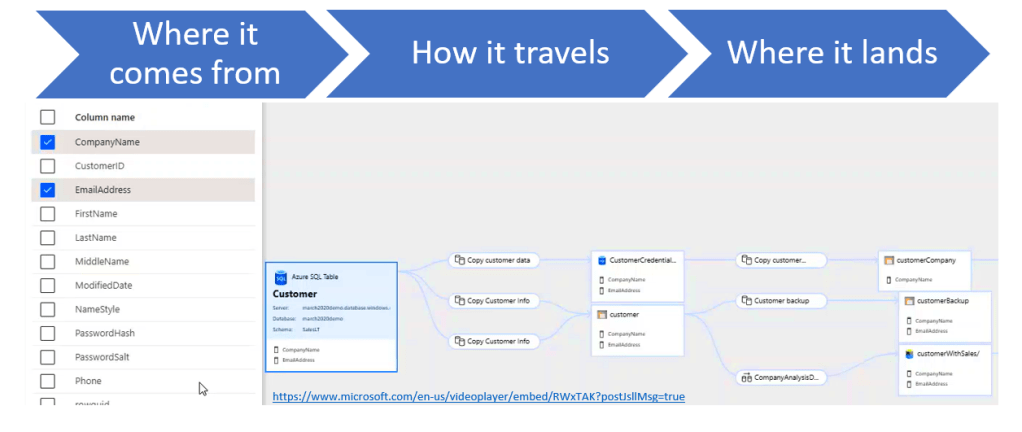
Data lineage gives you insight into how your data flows. It helps you understand how your data is connected and the impact of how changes to your data, processes, and structure, affects the flow and quality of your data. KNOW YOUR DATA FLOW. Find out where your data comes from, how it travels, the place(s) it lands, and ultimately, where it else it goes.
There are a lot of tools that will help you with data lineage; with various levels of sophistication. Long gone are the days where you must shift through excel sheets to figure it all out. That’s why graphical tools like Purview are really exciting for me. [Note: from initial insights into Purview costs once it’s past the preview stage – it gets pretty pricey, fast.] This is an image of Azure Purview and I wanted to show how granular it can get at the column level and how it travels through various processes and databases.
The column level feature is really really nice. It’s not necessary at this stage, but it certainly is helpful to you at the testing and troubleshooting phases. What you really need with your data lineage at this stage – and you can still see it in this graph – is how your dataflows between resources. Because this is a great way to discover things you may not be aware of in your data flow process that you need to pull into your migration plan.
What also can data lineage help with? Reporting considerations. Knowing what can break in a report, if you change at at the source is invaluable. While getting a big picture of what reports, models, applications may be impacted after a migration help circumvent some nasty surprises.
Pilot Project
If you haven’t moved anything to the cloud previously that is related to your infrastructure, then consider having a much smaller pilot project. One that will get you a feel for all of these steps but has a lower risk than your overall project.
What items do you look for in a pilot project?
Maybe you have a database that is only used for a small app that is low risk if the migration doesn’t go as expected. Try to keep your pilot project to applications with just a few dependencies. The goal of this is to a.) help you understand the process and b.) get you a quick win that you can show to stakeholders.
You want one that is low-risk, that is small enough to manage easily, but still large enough with a long enough duration to give you a good understanding of the processes involved. Besides size and duration, the criticality of your project is important. You want to incorporate a visible win that is important to your company that supports making bigger moves.
Finally, ff you’ve already done this previously, then this is when you review what you’ve learned from your previous pilot project. What were gotchas? What went really well? What is easily repeatable and what do you need to get down on paper?
Welp, we’ve come to the end of part 2. Feel free to hit me up with items you think I’ve missed or you want more clarification on. Next week is a much needed break for me, so [probably] no updates from me. Hope everyone has a wonderful Mother’s Day!
Super excited as this is the program that helped get me started with my speaking (along with nudges from several #sqlfamily in the community). The event is the 5th in the series and is tomorrow (May, 12, 2023). The event is free, but make sure to register here: https://www.meetup.com/datagrillen/events/291222930/.
In case you are unfamiliar with New Stars of Data, let me give you the quick summary: Ben Weissman and William Durkin from DataGrillen saw a huge gap in the community for getting new MS Data platform speakers up and running and helping to ensure the person’s success. (Ok, that’s actually an assumption on my part, but that’s my take on it.) Rather than just offer speakers a space to get noticed, they designed a program that partners the speaker with a mentor to help with every step of the way. Sometimes multiple people (both Ben and Gabi Münster helped me with mine). They help with topic selection, abstract, presentation development, and even practice run-throughs. There is also a free library for anyone to use to help improve your speaking skills. They remove the barrier of “I know this subject really well, but I don’t want to suck in a public forum”. Afterwards, the videos are available on YouTube (after the volunteers do all their wizardry to get it uploaded). So really what you end up with is a free event on current topics with great speakers.
I’ve mentioned this before, but I will also mention it continuously, attending these events (and/or watching the videos on YouTube) helps diversity in out community. By default, underrepresented people have a harder time finding mentors for stuff like this, which makes these programs super important. If that’s a topic that interests you – than make sure you support events like these.
While I’ve been in the sql community for many many years, I have to admit it was super exciting to meet a lot of the people for the first time last year at PASS DCS who directly and indirectly helped me during my New Stars of Data Event. As well as the many friendships that have developed since. It’s not always possible to meet those that have made such an impact in your life, but if you get the chance, it’s pretty awesome.
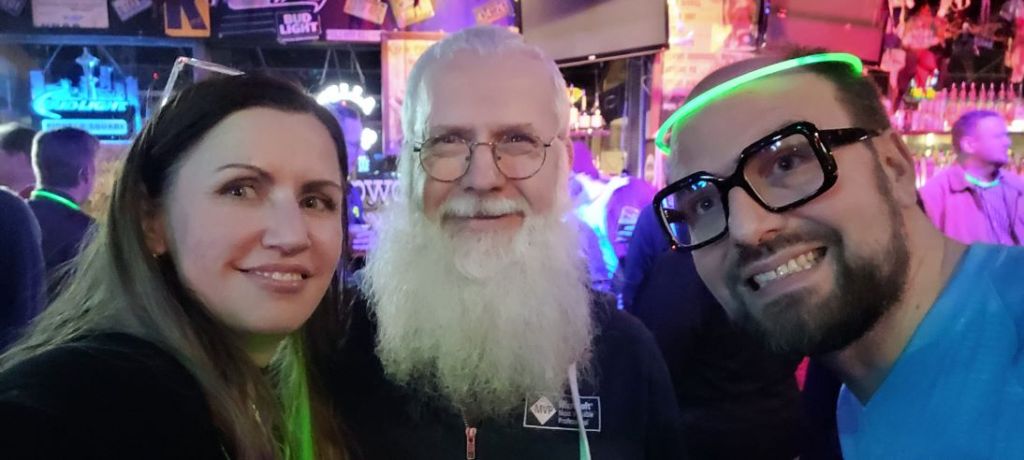
Me, Ben, and Johan at Karaoke night.
The event is tomorrow and it is on CET time (or maybe it’s GMT, I forget), but don’t let that stop you if you are in a different time zone! I plan to catch a few sessions as I am getting ready in the morning and during the remainder of the event. I’ll circle back around and catch the ones that are too early for me on YouTube. The session lineup looks really great, and I’m chuffed to see all the new and upcoming people. Really relevant topics on things like Power BI, Azure, Machine Learning, and other SQL/Data topics. Get your TRAIN on and join us if you can!!!!
As usual, it’s been a busy few week at my job and in my personal life, so I’ll try and make this short an sweet.
Weekly Wrap up (technically from the last 2 weeks):
Certification update
WITspiration
Women don’t owe you an explanation <rant>
DPWIT-DEI Mental Health and Wellness Day
Part 1 of blog series: Migrating data solutions to the cloud – a checklist
Favorite Items of the Week in the Wild
Certification Update
Back at the end of January I did a Microsoft Virtual Training Day for Azure Fundamentals because I remembered that if you did the Virtual Training Day, that some of the VTD sessions offer a free certification test if you take it in under 90 days. So I signed up thinking it would force myself to get it done and have a clock ticking. There was no reason for me not to take the test at that point: Class is free, test is free, can take both the class and test during work and online (a big deal because my kids could interrupt during the test otherwise, which is not allowed). I even told myself “I’ll put it just under 90 days out so I have chance to study”. (HAHAAHHA The lies we tell ourselves.)
The test is pretty broad and there are a few sections that I didn’t have experience in. Truth be told, I was at work so I frequently got interrupted during the VTD, but still got a lot of information from it. Even for the things I knew, but don’t necessarily use in my area, it was good reinforcement. I highly recommend using VTDs and other free resources such as Microsoft Learn, as part of your cert training strategy.
Long story short, I took the VTD, forgot about it, and then realized test day was upon me. Freaked out, studied additionally for a few days, and lo-and-behold passed. Yes there were a few questions that had stuff that was new to me, but it was a lot easier than I had put in my mind.
Long story short – sometimes it’s a good idea to take the plunge. Even if you don’t think you are ready. (That’s kinda my thing). I had a bunch of things going on that day that blew up on me, so I really didn’t mention it at all publicly. I’m trying to get better at announcing my accomplishments – so there you go.
WITspiration
Meanwhile we’ve begun our work with WITspiration! I met with all the members awhile back and today I had my first meeting with my Circle. SUPER excited to be in a circle with such amazing women! I forgot to ask permission if I can post their names, so will wait until I get thumbs up for that. But I think we are going to create amazing things while having a sound board for each other for all things. Stay tuned for more information and I will try and remember to tag it for easy filtering.
Women don’t owe you an explanation
<begin rant>
We interrupt this regular broadcasting to explain YET AGAIN that women don’t owe you an explanation. Recently a male reached out to me with a sentence that started along the lines of “EXPLAIN YOURSELF” in a DM. It was not about anything technical and quite frankly a little bit of common sense or googling and the person could have figured it out. It was not someone I know, but it was someone many in our #SQL community know. I’m not going to call the person out, but if you are reading this: YOU HAVE NO RIGHT TO ASK ME THAT AND/OR DEMAND I TELL YOU ANYTHING PERSONAL ABOUT MYSELF.
I didn’t reply because quite frankly I was in shock, than I checked with a few friends to verify that it was way out of line (it was, of course), and then I had other bombs drop on me that day that made the situation pale in comparison. Now in hindsight I wanted to make sure to call it out here because whether you are THAT guy or just a GUY LIKE THAT – I want you to know never, never ever, never ever ever, reach out to some woman you don’t know asking her to explain anything that is none of your damn business. And if you are starting a sentence off with “EXPLAIN” and it has nothing to do with a technical thing – I can assure you – it’s none of your damn business.
Honored to be speaking again for the Data Platform Women In Technology group and even more honored when I look at the great speakers lined up. Normally I don’t speak on non-technical things too often and this is my first session ever talking about Neurodiversity, so it will probably be way different than other sessions you have seen me speak on. If you are used to operating with 1000x things at a time – block off 11:30 AM CDT on your calendar and check it out (or many of the other GREAT sessions). Sign up here.
Part 1 of blog series: Migrating data solutions to the cloud – a checklist
Last, but not least, – Part 1 of 9 (yes 9) is out in case you missed it. This is the none technical, but very necessary items you need to make sure you do when planning a migration. It reviews key items you need to do for Pre-Planning and Evaluation. Next week I will push out Part 2: Discovery.
Favorite Items of the Week in the Wild
None.
Well, it’s not that there aren’t any, I just need to get this post out. I know, I know, I told you I would add it with each wrap-up, but I’m not this week and we are all going to just have to deal with it.
How bout this: I turned 51 on Wednesday, and as I’ve posted elsewhere: Being the same age as old people is weird, but I’m hanging in there.